Retirement Transition Coaching
Retirement isn’t an ending.
It’s a redesign.
I help boomers transition into retirement with clarity, confidence, and a plan that makes room for what matters-meaning, health, relationships, and the joy of learning new avocations (or reclaiming old ones).
Retirement Transition Coaching helps successful professionals and retirees navigate the emotional, social, and personal side of retirement. Together, we’ll create a meaningful next chapter built around purpose, connection, growth, and fulfillment.
A practical, optimistic coaching specialty built for your “next chapter.”
Most retirement planning covers money. Not meaning.
You can be financially prepared and still feel surprised by what retirement brings: loss of structure, shifting identity, changes in friendships, and the question: “What do I do with my time—and who am I now?”
My coaching focuses on the life side of retirement: creating a rhythm, rebuilding community, and turning interests into real, lived routines—so retirement feels expansive instead of vague.
Why I specialize in this
I’ve lived this transition myself. Like many people, I didn’t want retirement to mean “slowing down.” I wanted it to mean choosing—choosing health, learning, community, and contribution.
In my own next chapter, I leaned into purposeful routines, fitness, and community—then added (and revisited) avocations that brought back a sense of mastery and play. That mix—structure + meaning + joy—became the foundation for this specialty.
Nearly five years ago, I underwent an aortic valve replacement to correct a congenital heart defect. The surgery itself didn’t go as planned, and recovery was longer and more humbling than I expected. During that period, I found my way to a Hawaiian outrigger canoe club for men and women over 50 — a decision that quietly changed everything. I began paddling three mornings a week, covering 7–12 miles each session, and in the process rebuilt not just my strength, but my sense of rhythm, community, and purpose. Today, as I approach 70, I’m in the best physical shape of my life, surrounded by fellow kūpuna — growing older, wiser, and stronger together.
The 5 Ps: A simple framework for a meaningful retirement
This is the backbone of our work together. We create a retirement “operating system” you can actually live.
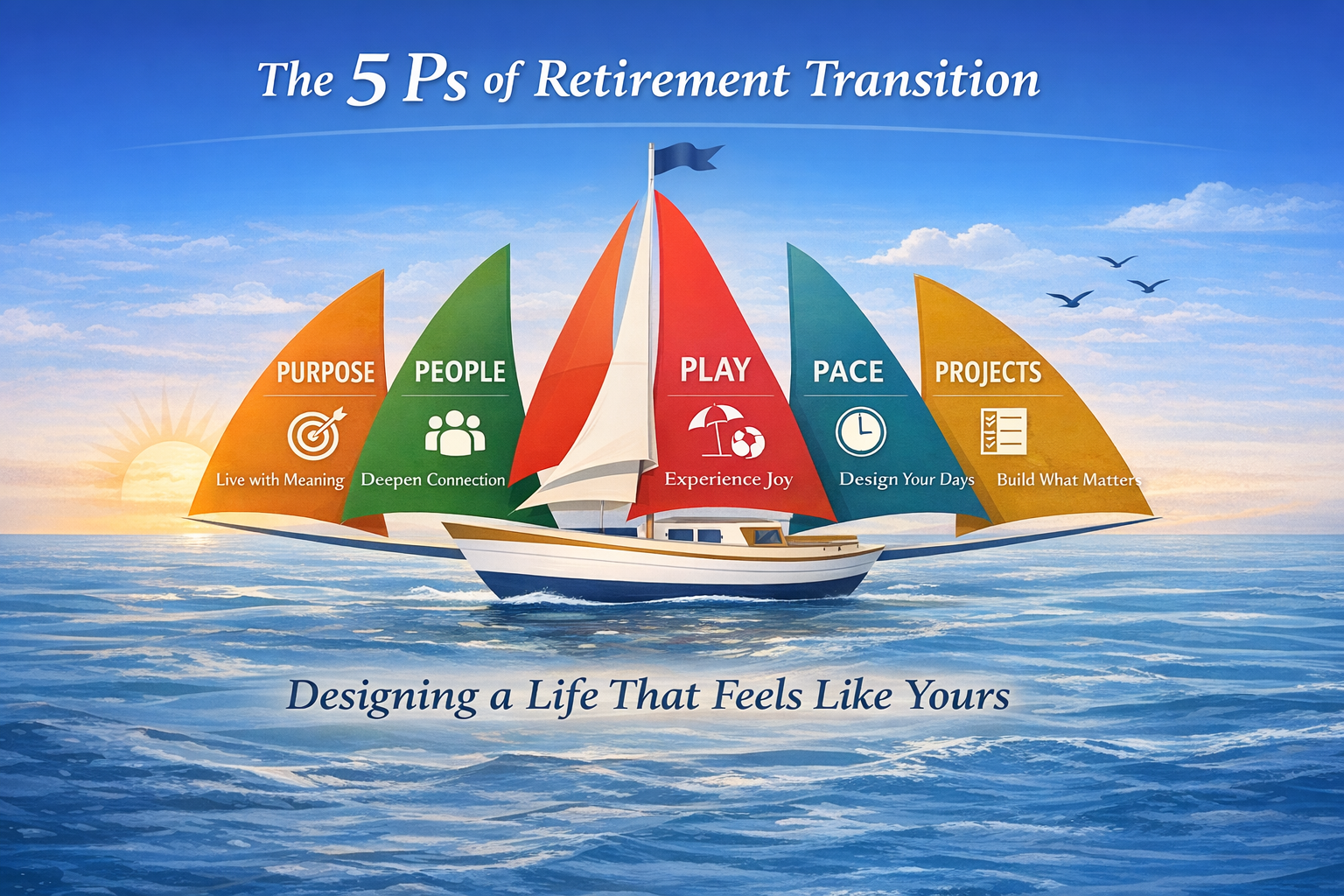
1) Purpose
Clarify what matters now—values, meaning, and what you want this chapter to stand for.
Identity shift: role → values
Vision for the next 1–3 years
What you want to feel more often
2) People
Retirement changes your social structure. We rebuild it on purpose.
Friendships, family rhythms, community
Groups/clubs/classes that fit you
Connection without over-commitment
3) Pace
Design a weekly rhythm that supports energy, health, and consistency.
Routines that feel good (not rigid)
Time boundaries and “anchors”
Energy management (movement, rest, sleep, recovery)
4) Play
This is the avocation engine: curiosity, mastery, and joy.
New skills and old passions
Tryouts: low-risk experiments
From interest → weekly practice
5) Projects
Optional, but powerful: contribution, creative output, and legacy.
Volunteering, mentoring, part-time work
Creative projects or travel goals
“Encore” contribution without burnout
What you’ll walk away with
A clear weekly rhythm that supports your health, relationships, and energy
One or two meaningful avocations you’re actually doing (not just thinking about)
A stronger sense of identity beyond your former job title
More connection and less “drift” or boredom
A 90-day plan you can follow with confidence
This is for you if…
You’re retiring soon (or recently retired) and want a confident plan
You’re excited—but also uneasy about structure and purpose
You want to learn something new or return to a passion you set aside
You want retirement to be active, connected, and meaningful
You and your spouse/partner are renegotiating “how we do life”
FAQ
Is this therapy or financial planning?
No—this is coaching. We focus on choices, structure, habits, and forward movement. If you need financial planning, I’m happy to coordinate with your advisor.
What if I don’t know what I want to do in retirement?
Perfect. We use structured “tryouts” to discover what energizes you and turn it into a realistic weekly plan.
Do you work with couples?
Yes. Retirement can be a major relationship transition. Couples coaching can reduce friction and build a shared rhythm.
Ready to design your next chapter?
Yes. The transition into retirement or a new life chapter often brings both opportunity and uncertainty. Coaching can help you sort through what matters most, explore new possibilities, and create a next chapter that feels meaningful and fulfilling.
What does a retirement transition coach do?
A retirement transition coach helps individuals navigate the emotional, social, and personal aspects of retirement, including purpose, identity, relationships, and the creation of a meaningful next chapter.
How is retirement coaching different from financial planning?
Financial planning focuses on money. Retirement coaching focuses on the personal side of retirement, including fulfillment, purpose, lifestyle design, and life after work.
When should I start retirement coaching?
Many people begin coaching six to twelve months before retirement, while others seek support after retirement when questions about purpose and direction emerge.
What if I don’t know what I want to do next?
That’s completely normal. Many successful people retire knowing what they’re leaving behind but not yet knowing what they’re moving toward. Coaching helps create clarity and direction.
In 20–30 minutes, we’ll clarify what you want and decide the best path forward.